Sitemap
Flying Elephant Films

Home Future Films Documentation Short Films Animation Current Contact Us Gallery Awards

Press Release

2nd October 2010

Virgin Goat, (Laadli Laila in Hindi) has been selected for the 15th Pusan International Film Festival (www.piff.org) and Abudhabi International Film Festival (http://www.abudhabifilmfestival.ae) as well as the forth coming Mumabi Film Festival (http://www.mumbaifilmfest.com)

--------------------------------------------------------------------------------------------------------------------------------------------------------------------------------------

3rd October 2010

Virgin Goat (Laadli Laila) has been selected for the International Film Festival of Rotterdam 2011.

-------------------------------------------------------------------------------------------------------------------------------------------------------------------------------------

15 OCTOBER, 2010

Screen Daily
Virgin Goat (Ladli Laila)
By Darcy Paquet
Dir: Murali Nair. India-France. 2010. 87mins

Virgin Goat

A carnivalesque satire about a farmer's desperate struggle to get his goat pregnant, Virgin Goat by Murali Nair is colourful, funny and mostly hits all the right marks. Although it won't be easy to market, the film's originality and humour should help to raise its profile among festivalgoers and arthouse audiences.

Virgin Goat's biggest asset is the charismatic performance by lead actor Raghubir Yadav.

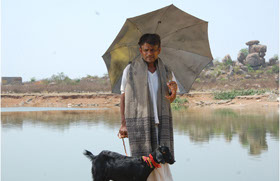
Kalyan, a middle-aged farmer, loves his goat Laila more than anything in life, including his bickering wife and his good-for- nothing son. The last remaining animal of a lineage that stretches back 500 years, to a flock bestowed on his ancestors by the King, Laila will not produce any kids.

Finally, after a visit to a dodgy-looking veterinarian, Laila appears to go into heat, and Kalyan sets off with her across the city to a waiting billy goat. However a high- ranking politician is planning a major rally on that day, and the police begin blocking off the roads.

Without a doubt Virgin Goat's biggest asset is the charismatic performance by lead actor Raghubir Yadav, who instils the character of Kalyan with enough life and charm to immediately pull viewers into his plight. The screenplay keeps him constantly agitated and moving, and especially in the film's first half his exploits and encounters with various outlandish characters is funny and engaging.

The film, which premiered at the Pusan Film Festival, then takes on a more despairing tone as it moves into the latter reels, leaving the work with somewhat of an edge instead of the feel-good conclusion some might expect.

Cinematographer Sandeep Patil's rich palette of saturated colours, and exaggerated costumes and makeup give the film a distinctive, memorable look.

Production companies: Maya Films, Films Unlimited
Producers: Murali Nair, Philippe Avril
Executive producers: Raad Ismael
Screenplay: Murali Nair, Jonathan Page
Cinematography: Sandeep Patil
Production designer: Preeya Nair
Editor: Emiliano Battista
Music: Fardin Khalatbari
Website: www.flyingelephant.co.uk/virgingoat/
Main cast: Raghubir Yadav, Shiela Naidu,
Saurab Gharipurikar, Purnima Maudgil, Archana Phadke

--------------------------------------------------------------------------------------------------------------------------------------------------------------------------------------

Sunday, Oct. 17, 2010

The Japan Times
Pusan festival delivers rich lineup of movies despite budget slump
By PHI LI P BRASOR
Special to The Japan Times


Earlier this year, Kim Dong Ho announced that the 15th Pusan International Film Festival, which ran from Oct. 7 to 15, would be his final one as the event's director. Kim launched PIFF in 1986 and quickly made it the most important Asian film event of the annual calendar. As a farewell gesture, the traditional trailer that precedes every screening was this year a cartoon showing how Kim used to cut through Busan's notorious traffic jams to get from one end of the festival to another on the back of a delivery scooter.

Kim is retiring due to age, and indeed the festival seems to need new blood. Though the South Korean film market is doing better after a mid-decade slump, PIFF faces budgetary problems and an apathetic central government. PIFF was once the pride of Korea, a festival that represented to the world Asia's most vibrant movie industry, and even this year it offered a record 101 world premieres out of 308 films from 67 countries. But the government in Seoul is said to be no longer sympathetic to PIFF's needs. Busan is traditionally a leftwing town, and the government of President Lee Myung Bak leans heavily to the right.

Consequently, the choice of Zhang Yimou's "Under the Hawthorn Tree" to open the festival sent mixed signals. Zhang is the most successful director to emerge from the so-called Fifth Generation of filmmakers who dominated Chinese cinema in the 1980s. "Hawthorn" is a return to the simple narrative style of Zhang's earlier films after a string of historical blockbusters and directing the 2008 Beijing Olympics. It's a love story between two young city people sent to the countryside during the Cultural Revolution, but as Zhang said at the film's press conference, "I put the political element as much in the background as possible."

The political element was in your face in the other hotly anticipated Chinese movie, "The Ditch," which marked the feature-film debut of documentarian Wang Bing, who 10 years ago made a nine-hour movie about the dismantling of the city-scale Tie Xi industrial complex in Shenyang. "The Ditch" focuses on a reeducation camp in the Gobi Desert where intellectuals and other "reactionaries" were sent in the 1950s to work the land. However, due to famine, all they did was starve to death. Though Wang still needs to work on his dramatic pacing, the film is harrowingly realistic. Needless to say, it was not produced with Chinese money.

"The Ditch" questions the common sense of leadership beholden to political dogma, and many films at the festival were cynical about leadership of any kind. Kyrgyzstan's "The Light Thief" depicts Central Asia's descent into corrupt capitalism with the tale of an electrician who provides fellow villagers with light when government and companies can't and, in the end, is punished for his ethical integrity. The Kafkaesque comedy "Virgin Goat," by Indian director Murali Nair, tells the story of a farmer who takes his beloved goat to town to have her mated, but is frustrated by security surrounding a visit by a big-shot whose identity and position are never stated. Though funny, it ends in abject misery.

Some directors tried to lighten their social criticism. Zhang Yang, who made a string of diverse, stimulating indie films in the 2000s, entered the big leagues with "Driverless," a slick, multiplotted romance centered on Beijing's burgeoning car culture that said nothing interesting about cars or romance. The big-budget superhero movie "The Red Eagle," directed by one of Thailand's most original filmmakers, Wisit Sasanatieng, was a formless, gory mess even as it took aim at the political corruption tearing Thailand apart. A more successful attempt at coming to terms with political shortcomings was "Sandcastle," a quiet story set in Singapore about

a teenager who discovers that the father he never knew was exiled by the government for refusing to renounce his views as a student leader.

PIFF's main rival for Asian premieres isn't other Asian festivals but ones in Europe. Thailand's Apichatpong Weerasethakul is a perennial PIFF favorite, but his Cannes Grand Prix winner "Uncle Boonmee Who Can Recall His Past Lives" wasn't screened at PIFF because it had already been shown at a festival in Seoul.

However, two other Cannes winners were. Iranian director Abbas Kiarostami, who was on hand to teach a master class, brought his first film set outside Iran, "Certified Copy," along with its lead, Juliette Binoche, who won the Best Actress prize at Cannes for her portrayal of an emotionally wrought woman taking an English scholar on a tour of southern Tuscany. But it was no match for "Poetry," former Korean Cultural Minister Lee Chang Dong's story of a grandmother's late-life discovery of literature as she faces a personal crisis of stunning moral impact. It won the Best Screenplay award at Cannes, and deserved it.

Though many of PIFF's films are small and obscure, crowd pleasers are welcomed enthusiastically. And while this year's edition made room for new movies by John Woo and Oliver Stone, the most talked-about big- budget movies were a pair of productions by Bollywood veteran Mani Ratnam. "Raavan" and "Raavanan" share the same story and some of the same actors, but the first is in Hindi and the second in Tamil. It is a breathless tale of kidnapping, pursuit and betrayal, augmented with songs by Oscar-winner A.R. Rahman. If the Tamil version has a slight edge in popular consensus, it's because superstar Vikram is better at playing a murderous bandit than he is at playing an obsessed policeman.

Another PIFF regular is Taiwanese director Tsai Ming Liang, who received this year's Asian Filmmaker of the Year Award. During his acceptance speech, Tsai ruefully observed that this was the first year he didn't actually have a film at the festival. However, Taiwanese art cinema seems to be experiencing a renaissance, exemplified by Chang Tso Chi's "When Love Comes," a superb example of what could be considered a unique Asian genre: the dysfunctional extended-family portrait. Unabashedly manipulative and fiercely acted, the movie kept the audience I saw it with in a constant state of emotional flux. It's why we go to the movies.

"Raavan" will play at the Tokyo International Film Festival (Oct. 23-30). "The Ditch," "Certified Copy," "Poetry," "Uncle Boonmee Who Can Recall His Past Lives" and "When Love Comes" will be shown at Tokyo FILMeX (Nov. 20-28). All will have English subtitles.

--------------------------------------------------------------------------------------------------------------------------------------------------------------------------------------

20 October, 2010

The National
Former oil rigger tells the tale of one man and his goat
Suryatapa Bhattacharya

ABU DHABI // Murali Nair's Laadli Laila is the story of a man and his goat. The film is a social satire about an impoverished farmer, Kalyan Singh, who is disillusioned with his family and authority. He spends his days taking his prized goat from veterinarian to veterinarian. The animal, he believes, is the descendant of a goat gifted to his ancestors by a king 500 years ago, and he is concerned about Laila's ability to produce the next generation.

The role of Singh is played by acclaimed Indian theatre actor, Raghubir Yadav, and was shot in less than a month in the Indian city of Hyderabad.

Laadli Laila(Virgin Goat) tells the story of Kalyan Singh (played by Yadav), who spends his days taking his goat from veterinarian to veterinarian. The animal, he believes, is the descendant of a goat gifted to his ancestors by a king 500 years ago, and Singh is concerned about Laila's ability to produce the next generation of prized goats.

Laadli Laila is the first Hindi script the director has worked on. His previous films, including the Malayali film, Marana Simhasanam (Throne of Death) was a critical success and won him a Camera d'Or at the Cannes Film Festival in 1999. But it was criticised in India, particularly in Kerala, for disparaging communism. Nair, who worked briefly as a geologist, turned his attention to films after despairing over the loneliness he felt while working on an oil rig off the shores of Mumbai.

"I got fed up of the subject," he said. "It was well paid, but very lonely and very monotonous, with just water around me. I never thought I would spend so much time alone."

After quitting his job on the rig, he travelled through India for a couple of months before settling in Mumbai to work on films.

"It was not easy. I am not from a privileged background, so my parents were very upset. I could not face them for two or three years," he said. "It was not the aura of filmmaking that attracted me to it. I had lots of stories to tell. The way stories were being developed in my mind, the way I was writing stories." He said the journey of Kalyan Singh reflected the journey of a person within society and himself. "As the film progresses, it becomes more emotional and intense," he said. "I see it all the time in individuals - their conflicts with society and organisations."

Abbas Khan, the first assistant director of the film, also travelled to Abu Dhabi with the crew for the screening of the film last night. After watching some of Nair's films, Khan wrote to Nair asking if he could work with him. "This is one of my favourite projects," said Khan. "There are lots of aspects that I like about the film, including the comedy, surrealism, the way the satire stood out and the way it was conveyed." Laadli Laila will receive a second screening at the Marina Mall at 7.30pm today.

sbhattacharya@thenational.ae

--------------------------------------------------------------------------------------------------------------------------------------------------------------------------------------

22 October 2010

The Japan Times

Murali Nair's Virgin Goat is a bleating delight
Gautaman Bhaskaran
ABU DHABI — Indian movie director Murali Nair once had long hair, which he neatly tied into a pony tail. His hair was a kind of logo that nobody could miss.

But the Nair seen at the ongoing Abu Dhabi Film Festival — where his fifth and latest work, Laadli Laila (Virgin Goat) was screened in the Competition, the only Indian entry in this section — had his head tonsured, or almost. The Indian Yul Bryner, perhaps.

Nair shot to fame, much like Shaji N. Karun, at Cannes with his first feature, Marana Simhasanam (Throne of Death, 1999), which won the Camera d'Or Prize there.

An interesting satire on capitalism and political corruption, the movie is, in the end, a profoundly moving human story of a poor farm labourer. Living in abject poverty and unable to feed his family, he is caught stealing coconuts and sentenced to death after false cases are slapped on him.

The story turns poignant when the government imports an electric chair with the help of the World Bank, and decides that the farmer would be the first to be executed on it. Nair's has always had this fascination to turn his cinema into social documents. His second film, Pattiyude Divasam (A Dog's Day), is a comic drama that examines how political power gradually shifts from monarchy to democratically elected representatives. "My cinema is always conflict driven," Nair said during an interview at the festival on Wednesday. "I am inspired by what happens around me, and my own reactions and responses to them."

A couple of movies after Pattiyude Divasam, Nair has now stepped into a different language, Hindi, instead of his usual Malayalam, with his Laadli Laila. He decided to switch to Hindi "because the Malayalam film market is dying". It became clear to him after four films that the market in his home state was going nowhere. It was stagnant. "So, I decided to call it quits with my mother tongue, at least for my movies."

Also, Nair feels that the Hindi movie industry is no longer against those who speak a different language. "Once, there was a strong resentment against those who came from other states. But that is now gone. When I made Laadli Laila, not one person asked me where I came from. People are looking at style, content and so on and not the language they speak." Laadli Laila has its own unique style. A satire of sorts, the film narrates the pathetic plight of a farmer, Kalyan Singh (played by Raghubir Yadav), who is so disillusioned with not just his immediate family of a nagging wife and a lazy lout of a son, but also the political authority that he turns to his virgin goat, believing it to be something special. He is sure that the animal has descended from a goat gifted by a king to his ancestors some 500 years ago, and Singh is terribly worried that she might not conceive and keep the royal lineage alive.

His trip from one vet to another is hilarious, and when Laila, that is the name of his goat, is taken away from him, his misery knows no bounds. But before that, when Laila appears to be in heat, Singh's excitement to find a mate for her leads him to unbelievably funny situations.

Nair, who wrote the story and co-wrote the script with Jonathan Page, captures a medley of characters as Singh journeys on his quest to get Laila mated.

The politicians, the godmen, they are all there to give Nair's screen a great colour, but it is Yadav's charismatic performance as the farmer who swings between ecstatic joy and depressive sorrow that is bound to capture the attention of viewers.

Nair hopes that Laadli Laila would attract a much wider audience than his earlier movies could. Also, "as a creator, I tried to do something different in this work, and that has been immensely satisfying to me", Nair avers.

The film is set around Hyderabad, and was shot in just 30 days. "I always finish my movies in about the same time," Nair quips. And he is very proud of Hyderabad, a city he is now settled in with his wife and two children. The Nizam of Hyderabad was so visionary that he encouraged people from various places to settle in the city to give it a certain richness. So, there is a wonderful charm about Hyderabad, Nair feels.

Will that work magic with his audiences?

(Gautaman Bhaskaran has been covering major film festivals across continents, and is now at Abu Dhabi. He may be contacted at gautamanbhaskaran@yahoo.in)

--------------------------------------------------------------------------------------------------------------------------------------------------------------------------------------

4 September 2010

Sooting of Hyderabad complaint choir completed.

For Immediate Release 23rd July 2010

Flying Elephant Films announces audition for their new project Hyderabad Complaint Choir
Flying Elephant Films is pleased to announce audition for their forthcoming project Hyderabad Complaint Choir.
The film will be produced in collaboration with Isabel Collins and Venkat Reddy.
Shooting will be done in and around the hitec city of Hyderabad by the end of August.
Anyone who has a complaint, and anyone who wants to sing it aloud, please mail us for an audition.

For further information, please mail us at info@flyingelephant.co.uk

--------------------------------------------------------------------------------------------------------------------------------------------------------------------------------------

25th September

Previewed three of our films at Prasad Previed theatre in front of an invited audience. The screening of Virgin Goat was attended by most of the cast, who are from Hyderabad. This was the first screening of Quamar: Working to Live, in Hyderabad. This film was shot two years ago in the old city area of Hyderabad. Please see click on http://www.flyingelephant.co.uk/quwork.html for further details.

The third film was Hyderabad Complaints Choir, a new production. Please click http://www.flyingelephant.co.uk/aicc.html

--------------------------------------------------------------------------------------------------------------------------------------------------------------------------------------

Thursday, 18 March 2010 08:35

Oye Times
Virgin Goat
Written by Murali Nair
Set in present day India, Virgin Goat is the darkly comic story of a farmer' s obsession to have his goat mated.

However, family trauma, bureaucratic red-tape, a marauding mob conspire to turn a simple journey into a nightmare and force KALYAN SINGH to confront the painful realities of his life which he tries so hard to avoid.

Kalyan Singh is a dissatisfied but humorous, middleclass farmer, whose forefathers were brought to the present village where he lives by then ruler. Fed up with his wife' s nagging and his lay-about son, his only joy comes from tending his animals. The daughter he dotes on is married and lives away from home.

Kalyan' s only possession in this whole world is Laila , the female goat. She is the only one left in a once prolific lineage, which was again brought to the province from his ancestral land. Kalyan had to sell off all of the other goats to meet dowry requirements for his daughter.

Past the marriageable age, Laila still shows no sign of being on heat. Kalyan gets some special medication to get her one heat. Eager to have a goat of his mated by the finest Billy-goat in the district, Kalyan Singh asks his son to take her to a stud farm nearby. When his mother refuses to let her son venture out in the heat (he has exams coming) Kalyan Singh must make the journey himself. Not even a surprise visit from his beloved daughter can stop him.

Kalyan Singh' s journey soon turns into a bizarre and surreal adventure. No sooner has he left that he hears that a large rally is to be held for a visiting dignitary right next to the farm. Though it is not clear who the dignitary is, a worker in the fields warns him it won' t be safe with such a large police presence. His irritation increases when he encounters the surreal sight of special coconuts being collected by government officials for the occasion. In a teashop nearby, Kalyan Singh' s friends also warn him against carrying on. They advise artificial insemination from a vet instead, but Kalyan Singh is suspicious of this technology and is determined not to be put off by the authorities.

Kalyan Singh becomes increasingly confused as to who the dignitary is who is coming – a Christian priest suggests it is a religious visitor, but an IT student assures him it is software genius from America. Meanwhile the build up of police in the area points to a politician being the star attraction. When an overzealous policeman tells him not to proceed any further, Kalyan Singh ignores it and he is joined by sympathetic –if annoying Old Man on his journey to have his goat mated.

Having ignored everyone' s advice, Kalyan Singh is then picked up by the police. Detained without charge in a poultry farm, converted into a police station, the police finally send Kalyan Singh on his way. However, they have mixed up his goat and offer him a male goat to take instead. Incensed Kalyan Singh tries to complain – but his protests fall on deaf ears. It is the beginning of another chapter in his life.

© 2010 Flying Elephant Films
Developed by Trillion